Biosphere How to Draw a Step by Step Easy Dog
Hot Topics
Indigenous Vegetables
Colette Day, WPB Foundation Director and Chair of the Foundation's Science and Education Committee
Indigenous vegetables are making a popular resurgence to our diets and rightly so. They are easy to grow and maintain being perfectly adapted to our environment, nutritious and add a new and interesting dimension to our settler diets. Amazing to have to say this after over 200 years of European settlement in Australia! Two particularly useful plants are indigenous to our Biosphere and are part of the Sustainable Indigenous Garden at the Down's Estate Community Farm.
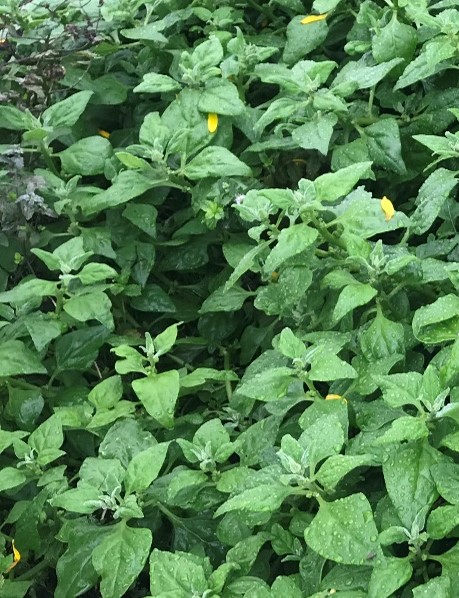 Warrigal Greens – Tetragonia tetragoniodes
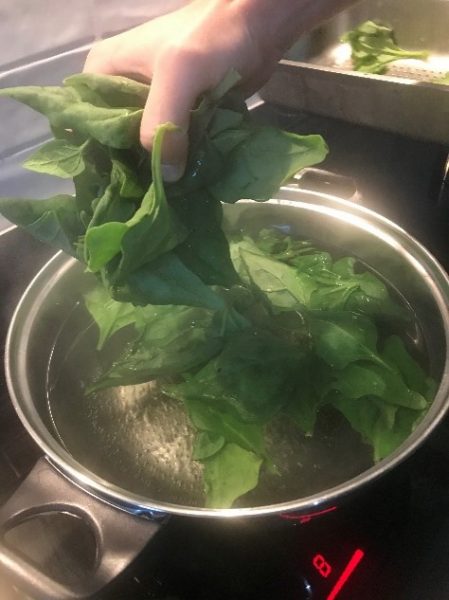
is a leafy green vegetable that grows in sunny to shady spots in most parts of Australia. Fertile, moist soils are best for good leaf product, but these hardy plants adapt to hot, dry, and sandy soils and show resistance to salty spray. In our Biosphere, these plants may die back during Winter but will revive in the Spring and can be treated as an annual. They are well suited to pots in smaller gardens. The leaves can be picked off and used as you might spinach, and it is best to blanch and rinse the leaves as there may be a build up of oxalates if eaten frequently.
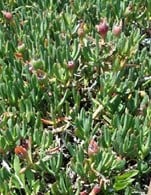
Karkalla or Pigface; Carpobrotus glaucescent
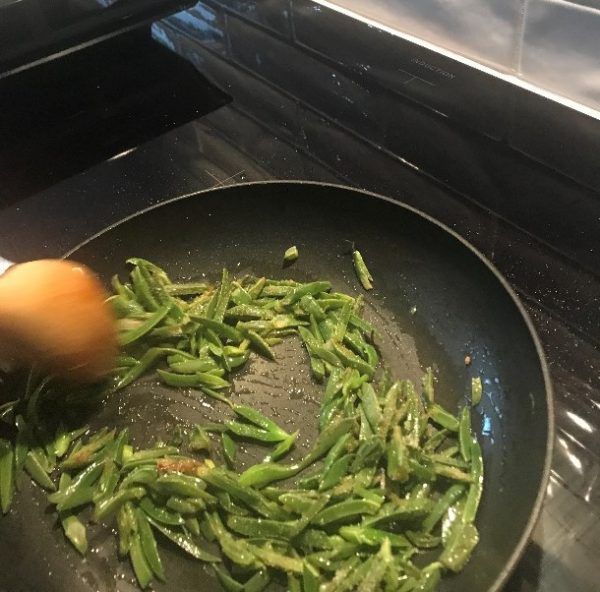
is a coastal succulent so tolerates both drought and salt and is somewhat frost-resistant. It prefers full sun but will grow comfortably in part-shade. Choose a well-drained soil, from clay loam to sandy, and water occasionally during the hottest summer months if you want the leaves to keep their rich colour.The juicy leaves can be eaten raw or stir fried. They also can make a crunchy green pickle which is a great accompaniment with cheese and crackers or on a BBQ steak!
Check with your municipal nursery for seedlings of these two great indigenous vegetables. Once established these plants can provide cheap, nutritious, easy additions to your everyday meals.
Stir fry Karkalla and Blanched Warrigal greens
You Simply Cannot Beat an Egg
Greg Hunt, WPB Foundation former EO and avid birdo
As an exercise in biophysics and biochemistry, there is simply nothing better than an egg. Sure, there are challenges in ovipary (egg-laying) as a reproductive strategy, but millions of years of evolution have led to an egg as a rather astounding structure, physically, chemically and aesthetically.
First, the challenge. Mammals have pretty much perfected the process of ensuring the next generation by retaining their offspring within the maternal body, being kept warm and safe by the parent with experience and skills to stay secure from predators. Carrying within the body a number of developing offspring isn't an option for an animal that flies, that's a considerable weight to carry around. Forming an egg and then passing it out of the body is the avian solution to this problem. Even in a relatively undeveloped state, before the eggs are laid, there's still a handicap in the weight of the eggs. Particularly for birds that rely on flight to catch prey, breeding time could be problematic. If you cannot fly fast and long, you go hungry and your eggs don't mature. In falcons, goshawks and other birds of prey, the female is larger than the male. A male Peregrine falcon, weighing on average 600 grams, is a 'tiercel', a word derived from archaic French meaning 'one third smaller'. Females average 900 grams. Through a better power-to-weight ratio, female Peregrines can carry developing eggs and still hunt on the wing.
With the eggs completing development out in the variable external environment, a number of challenges follow. They have to be kept warm and they have to be kept secure. A nest serves as a response to both of these challenges.
Lined with heat-retaining feathers or fine grasses, the incubating parent passes their body heat to the eggs. The nest provides an insulated environment against the temperature variations that might otherwise stop foetal development.
For security, the nest might be completely enclosed, contained within a hollow, a tunnel in an earth bank or a stick or grass dome with a small side entrance. It might be a suspended cup, entwined in the outer foliage of a bush or tree that would not support the weight of a foraging monitor or possum. It could be concealed within the spiky defences of a clump of porcupine grass or thorn-encrusted thickets of shrubs.
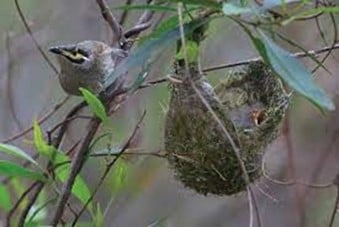
At the nest—the tiercel (left) and male (right)
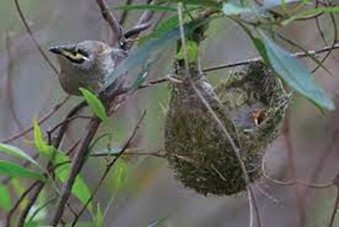
Yellow-faced honeyeater builds a suspended cup in the outer foliage
Nest building requires energy and resources and some species just don't do it or if they do, they do it rather sparingly. For pigeons and cooing doves, it is a case of 'two sticks across and a little bit of moss, and that will doo, doo doo.'
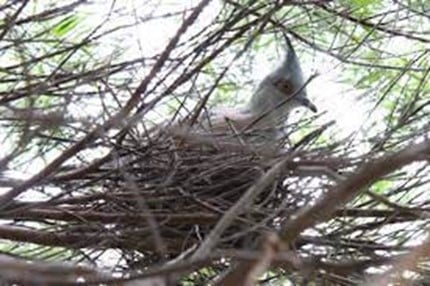
Flimsy nest of a crested pigeon
Frogmouths will never win awards for excellence in nest building either, with just a few twigs laid out on a horizontal fork in a sturdy gum where at least there is little swaying, even on a strong breeze. Cuckoos don't even bother, they simply parasitise the nests of others and foster out incubation and raising their young.
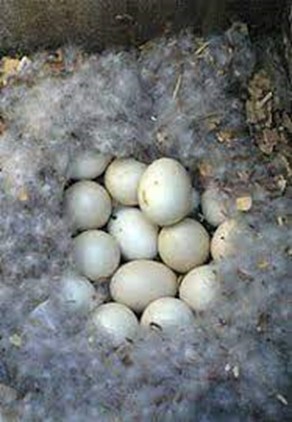 Down lining of a wood duck's nest
Some birds of prey take over the nests of ravens for their own use. Other species, including lapwings, dotterels, and terns use a scrape in the ground, sometimes lined, sometimes not. For them, security is a mix of concealment and parental defence.
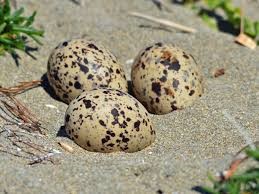
The 'none' nest of the pied oystercatcher
But back to the egg, a structure largely composed of insoluble calcium carbonate, inside of which the embryo develops in a fluid environment. Gasses pass through a semi-permeable shell and internal membranous sacs isolate the nitrogenous wastes from protein synthesis. Creating the shell requires energy and resources.
A sphere can enclose the greatest volume within the least surface area. It is least wasteful of energy and resources for a bird to have a spherical egg. If the egg is laid on the ground or on a flattish platform of twigs, it can readily roll around – and away. Birds that build in hollows, where there is nowhere to roll to, can afford to produce spherical eggs. This is the shape of eggs of parrots and kingfishers, both hollow-nesting species, or rainbow birds, which nest at the end of a metre-long tunnel in sand.
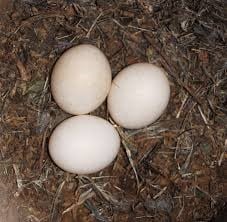
Near-spherical eggs of a hollow-nesting eastern rosella
A clutch of spherical eggs clumped together will necessarily leave gaps in between where they touch. If the incubating bird is trying to cover all of the eggs with their body warmth, spheres aren't the best shape.
Reflect on how the wedges of a pizza fit together. Conical-shaped eggs can be gathered with their pointed ends inwards to provide the best opportunity for each to receive parental warmth as more eggs will fit under the bird. If they were to roll, it wouldn't be away, it would be around and the parent bird can simply nudge them together again.
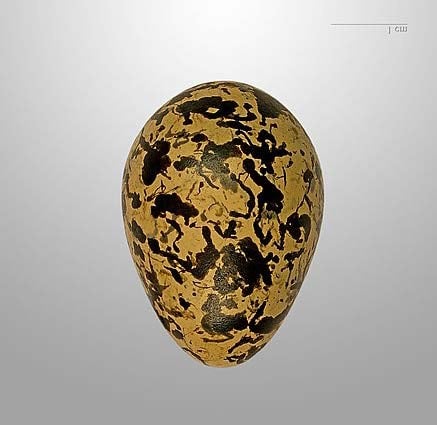
Conical egg of a painted snipe
There are further advantages to nesting in hollows. Not only are eggs the most efficient shape, they also don't need to be camouflaged. In fact, the advantage is in dispensing with the production of pigment altogether, as a white egg is easier for the bird to see when it enters the darkened hollow. Further, safety from predators is greater when the eggs are so hidden and defence by the parents is simpler.
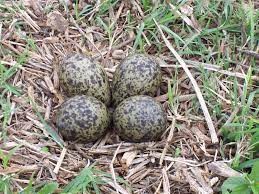 Masked lapwing—pointed ends in
There is some great architecture in bird nests. Australia has a number of mound-builders, where mallee fowl and scrub turkeys lay their large number of eggs in a heap of decaying vegetation, harnessing the heat of decomposition for incubation. Mudlarks, choughs, swallows and fairy martins build quite elaborate mud-nests, as bowls or bottles, in which to lay. The large bowl of a white-winged chough will have the many eggs of the extended family group.
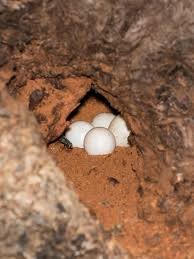
Sacred kingfisher nest and eggs
There is some great architecture in bird nests. Australia has a number of mound-builders, where mallee fowl and scrub turkeys lay their large number of eggs in a heap of decaying vegetation, harnessing the heat of decomposition for incubation. Mudlarks, choughs, swallows and fairy martins build quite elaborate mud-nests, as bowls or bottles, in which to lay. The large bowl of a white-winged chough will have the many eggs of the extended family group.
If the nest is on the ground, the trade-off is between reduced effort in nest-building and greater vulnerability to predation. The first line of defence is camouflage. An egg with colours and patterns that blend into the background provides some advantage against predators. The biochemical pathways that result in background egg-colour, then coloured blotches and streaks need inputs and energy but the payback will be eggs that are hard to see and so more likely to result in successful fledging.
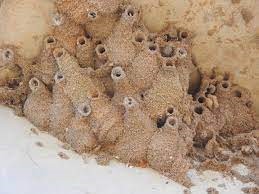
Bottle-swallows, or correctly, fairy martins,' nests
The second line of defence is up to the parent birds. Fierce defence of the eggs and young is a strategy of many species. Masked lapwings were previously known as Spur-winged plovers for the sharp spur on the elbow joint of the wing. This is a spur to avoid as the lapwing dives at whoever or whatever approaches the nest. Magpies can make parks dangerous places in Spring as they swoop pedestrians who stray within their territory. Swans can be quite frightening in attack if the personal space of their cygnets is invaded. Miners, mudlarks and willy wagtails appear fearless as they mob and drive off currawongs, ravens and eagles, many time their size.
Rather than drive away predators, some species lure them away. If a Red-capped plover thinks the eggs and/or chicks are in danger, it will lead a predator away by posing as an easy meal through having a broken wing and take the threat away from the nest, only to fly off and around when the danger has been sufficiently reduced.
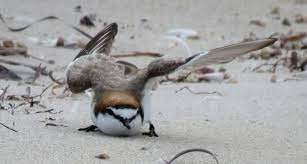 Broken wing display of a red-capped plover
Of course, unprotected eggs or vulnerable chicks are an easy meal for a scavenging gull or a candidate for squashing by a beach-driven 4WD. An off-leash dog also will scare off a parent bird to leave the eggs or young exposed.
A third strategy is in the number of eggs. It is common for emus, ducks and geese to produce at least 10 eggs, accepting that not all will survive to fledging. It has been estimated that the success rate from egg to independence is around 5%. We'd be swamped by birds if all eggs laid were to develop through to adult birds so food chains in which birds appear as intermediate links are simply a feature of the natural world.
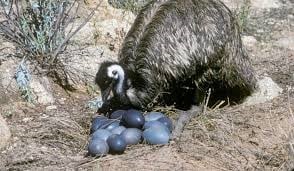
The typically large clutch that a male emu incubates
And finally, many species are opportunistic breeders, if the food resource is there, they will have second and third broods. In a good season, willie wagtails will keep up a production line of young to spill over the tightly-woven, spiderwebbed, cup-shaped nest.
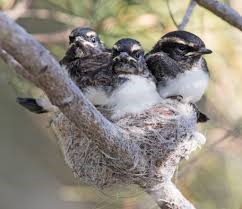 Willie wagtails typically build a nest of cobwebs and fine grass on a horizontal branch often above water
There's considerable energy invested in reproduction and egg-layers, as do all species, want to see a return on that investment. Accordingly, there is a plethora of adaptations to maximise that return. Approaching the matter from first principles is a fine way to understand these adaptations and appreciate how birds reproduce.
Water Stewardship in the Biosphere
Lance Lloyd, Water Stewardship Program Officer, WPB Foundation
Managing water is vital to support the sustainability of our Biosphere. Applying the international recognised standard of Water Stewardship helps property owners and managers understand, reduce and recycle water quantity, improve water quality and add to the biodiversity of their site, and important water-dependent environments downstream of their site.
While the Covid pandemic has been making it difficult to get things done, we have been working with funds from the Community Environment Program, and the local member in Dunkley, Peta Murphy, to develop plans with the Peninsula Campus of Monash University and the Minimbah campus of Woodleigh School.
The Commonwealth Government has also supported the Biosphere under the Environmental Restoration Fund. We hope to extend from these Frankston-based water stewards to additional sites in the municipalities of Bass Coast, Cardinia, Casey and Mornington Peninsula, to develop new water stewardship plans and train new water stewards.
We are keen to hear from any schools, businesses, organisations, or farmers that would like our assistance to make sure they can save water, money, nutrients and improve water quality as well as increase biodiversity onsite and within the catchment. We can tailor the water stewardship plan to suit your needs. For instance, Somers School Camp has approached us to be part of the water stewardship program and even though we haven't been able to get together onsite yet, we are discussing their needs and are planning some intensive bug bioblitzes and water quality monitoring at the Merricks estuary and Coolart Wetlands, both important water-related areas near several Water Stewardship Plan sites. Please email Lance Lloyd at water@biosphere.org.au.
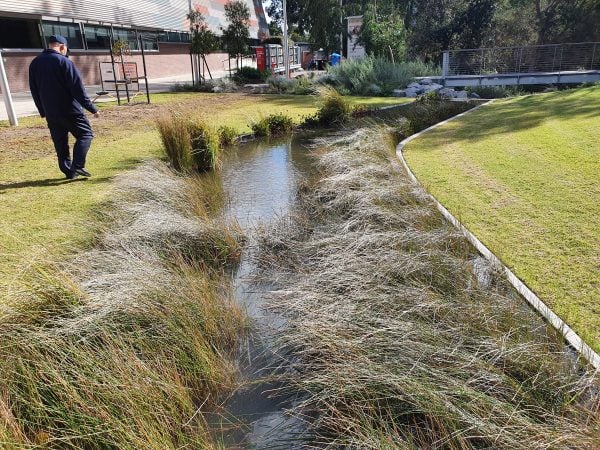 Water treatment wetlands at Peninsula Campus of Monash University – already working to improve the water quality run-off and the biodiversity of the campus.
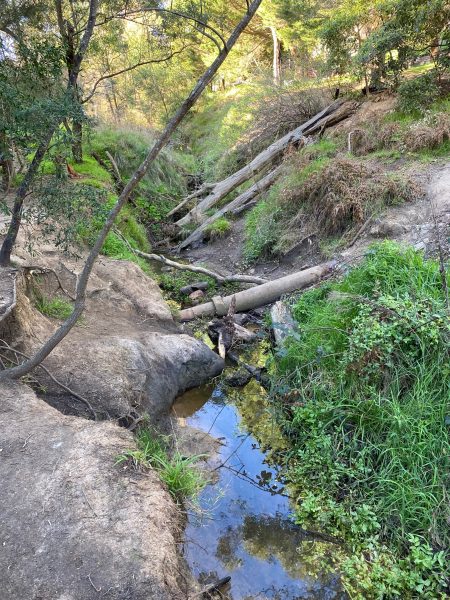 South Branch of Sweetwater Creek at Minimbah campus, Woodleigh School – a target of activities for students, revegetation and a future bug bioblitz!
Protecting the Ramsar Values of Western Port
Stephen Brend, WPB Project Officer
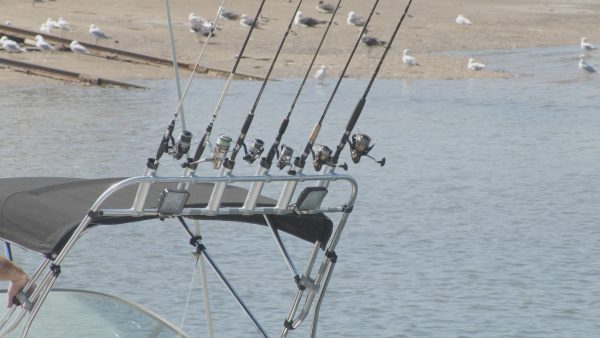 Photo Courtesy Daniel Hall
Our three-year 'Ramsar Values' project, funded by the Port Phillip and Westernport Catchment Management Authority (PPWCMA) wrapped up successfully in June. The project's final event, a bus trip to highlight why Western Port is considered a wetland of international importance, was postponed due to the pandemic lockdown. It will, however, certainly be run once restrictions allow. We will advertise this before the event. Protecting the Ramsar Values of Western Port remains a priority for the Biosphere Foundation.
In the meantime, the lockdown has made many people ask "what effect will the lockdown have on fish stocks? Will there be more fish? Will they be easier to catch?" To the surprise of many, fisheries scientists answer "probably not". How can that be? If thousands of recreational fishers are prevented from catching fish, why won't there be more of them? As with everything to do with fisheries, the explanation is complicated. There are lots of fish species, each with different life histories, some are affected more by adult mortality (e.g. fishing) than others. However, it really comes down to the incredibly large number of eggs a single fish can produce – sometimes in the tens of thousands. As a result, it doesn't take too many adults to do a lot of replenishing. In the case of King George Whiting in Victoria, the adults spawn (lay eggs) out at sea where they are not fished. It is then up to the currents and tides to bring the eggs and young into our bays where they mature. The lockdown will mean that more adults will leave their 'nurseries' in Port Phillip and Western Port and make it out to sea to reproduce, but predictions are, this won't significantly change fish stocks.
What about the fishing itself? Surely, if those thousands of fish haven't been caught, there will be more of them in the water and so they will be easier to catch? Possibly, but only possibly. The fish will be as elusive as ever. The only thing that might help fishers is that school sizes may be bigger, making them easier to find. Whether you consider that a good thing or not, depends on your passion!
The Foundation's attitude is nuanced. Firstly, we feel deeply the impact that lockdown has on individuals and society. While environmental gains are always worth celebrating, there is no joy when it comes at such cost to people. We recognise that recreational fishing does bring social and economic benefits. Our concern is making sure it does not come at a cost to the natural world. Therefore, we always encourage best practice: Not littering; retrieving all spent line; anchoring without damaging the seabed; and avoiding disturbing birds. Regardless of whether fish stocks have improved, or if catching them has become easier, our message is always about sustainability. Catch your dinner, not your limit.
Introducing Spartina (and myself)
Katerina Palthe, WPB Foundation Intern
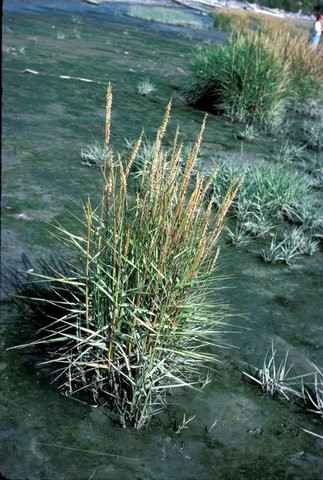 Sporobolus anglicus (Photo: Fred Weinmann)
https://nas.er.usgs.gov/queries/FactSheet.aspx?SpeciesID=1126)
I have been lucky enough to join the Western Port Biosphere Foundation as an Intern during the latter half of this year. Currently, I am completing a Master of Agricultural Science, but I have a background studying geography, development, and environmental politics. Living on the Mornington Peninsula, I've always appreciated the natural beauty of Western Port – in fact – most weekends you'll find me surfing around the Western Port entrance!
My favourite part of this professional experience has been working with the Foundation's Team and learning about the people and processes that contribute to enhancing the Biosphere. I've had the opportunity to research meaningful issues, attend meetings and seminars as well as correspond with a variety of professionals. Recently, I was tasked with researching the progress of Spartina eradication, which has not yet been discussed in a Connector newsletter before!
Spartina – technically "sporobolus anglicus," and also called "common cordgrass" – is a weed that invades the Western Port intertidal zone. The pest rapidly colonizes mudflats that facilitate fish breeding, native plant growth, and provide food for migratory birds, disrupting the natural ecosystem. In response to the worsening threat of Spartina in the Western Port environment, Melbourne Water developed a program aiming to completely eradicate it with the help of Parks Victoria and the Port Phillip and Western Port Catchment Management Authority (PPWCMA). Being in year 6 of the 10-year management plan, I corresponded with Adrian Vinnell (Melbourne Water) and Andrew Morrison (PPWCMA) to discuss their thoughts on its progress.
The focus of their management plan so far has been the Inlets Management Area and Bass Estuary. Through aerial spraying, the extent of Spartina infestation has significantly reduced, associated with an increase in saltmarsh and mangrove quantity. Whilst aerial spraying has been successful, they are now shifting their focus towards ground-based detection and monitoring, possibly through drones and canine detection.
Unfortunately, the threat of Spartina will endure for many years to come. Infestations are difficult to locate as re-establishment can occur on private property and be re-introduced to areas where Spartina was previously eradicated. The very nature of Spartina growth – being horizontally under soil – makes the task of eradication quite a challenge. Nevertheless, there is hope that with increased awareness and education, community efforts could contribute to monitoring. Therefore, we all have an opportunity to prevent infestation and ultimately protect the wildlife of our beautiful Western Port Biosphere.
The Western Port Biosphere Foundation would like to hear from you on your experiences with this weed and any advice or ideas on how we can continue to manage its invasion. Please make contact through our website at https://www.biosphere.org.au/contact/.
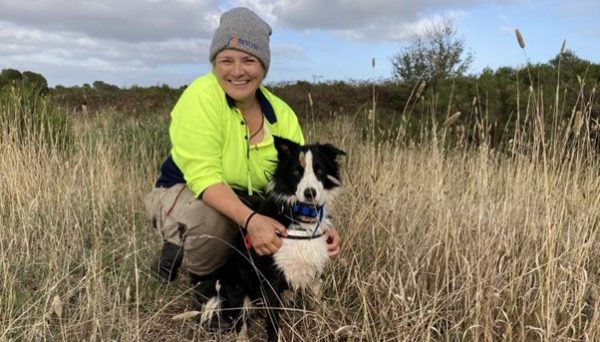 Detector dogs can be trained to sniff out spartina! (Photo: Melbourne Water)
https://www.melbournewater.com.au/water-data-and-education/news/wonder-dog-recruit-sniffing-out-wild-weeds)
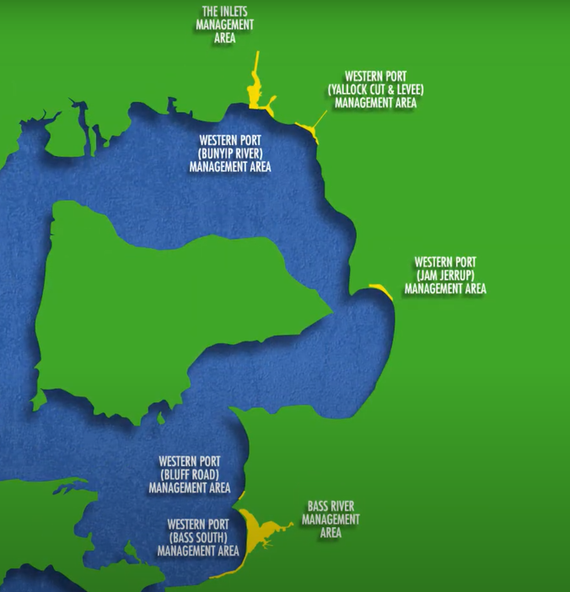 The distribution of Spartina in Western Port (Image: Melbourne Water)
Bandicoot Fence Thank You
Bandicoot Corner
Meghan Lindsay, Project Officer, Cardinia Environment Coalition
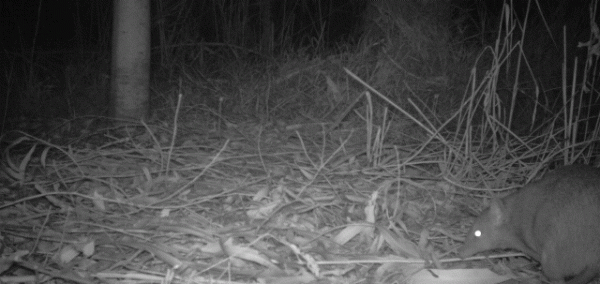
The Cardinia Environment Coalition has been operating since 1998. We manage several nature reserves in Cardinia Shire, including Bandicoot Corner in Bayles. Bandicoot Corner is a 3ha reserve of swampy riparian woodland, an endangered vegetation type. The reserve is home to a population of southern brown bandicoots, a federally listed endangered species. Southern brown bandicoots are marsupials with a stocky body, long snout and rounded ears. Adults weigh 1-1.2kgs, which puts them in the 'critical weight range'. The critical weight range is a class of mammals in Australia that weigh between 35-5500g. Due to their size, this group of mammals are at high risk of decline and extinction, largely from predation by the introduced red fox and cat.
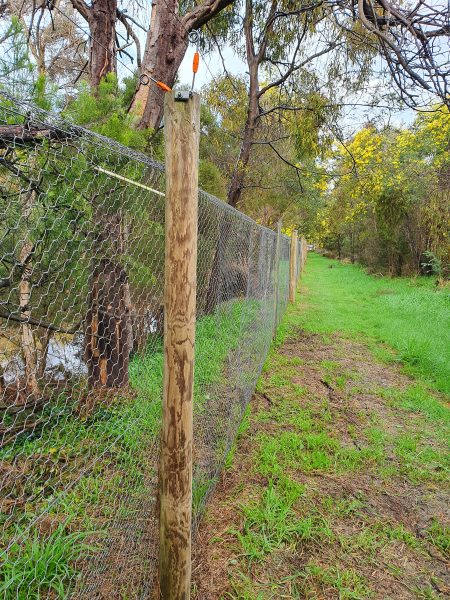
Bandicoot Corner has been surrounded by a predator proof fence since 2012. This fence protects the bandicoots from being predated by foxes and cats. Whilst predator proof fences can be an effective way to protect vulnerable species, they require constant maintenance and upkeep, which can be time consuming and expensive. The Mornington Peninsula and Western Port Biosphere Foundation kindly provided funds to help us do some much-needed repairs to the fence in July 2021. With their help we were able to clear vegetation from the fence line and repair sections of the fence that had been damaged by fallen trees. This work will help us make sure that Bandicoot Corner remains a safe haven for southern brown bandicoots into the future.
Meghan Lindsay
Project Officer
Cardinia Environment Coalition
Phone: 0408 277 129
Web: www.cecinc.net.au
Facebook: www.facebook.com/CECCardiniaEnvironmentCoalition
Hastings named Australia's most Sustainable community

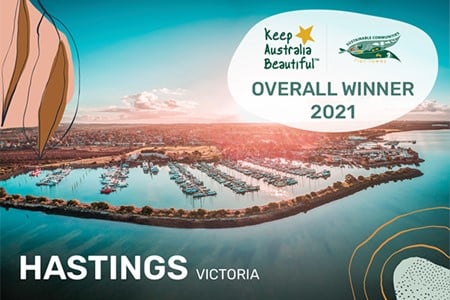
Keep Australia Beautiful has announced the Victorian finalist Hastings as the winner of the 2021 Australian Sustainable Communities – Tidy Towns Awards, at an online event held on Friday 3 September 2021.
Running nationally since 1990, the Australian Sustainable Communities – Tidy Towns Awards have evolved to encompass projects and initiatives with a focus on environmental sustainability and resource management to reflect a growing awareness of the importance of community-led environmental action. The Tidy Towns name has always been synonymous with community pride, cohesion and above all, community action. The awards reach beyond tourism to encourage, motivate and celebrate the sustainability achievements of grassroots rural and regional communities across Australia.
Traditionally, the 2020 overall winner, Beechworth, Victoria, would have hosted this year's awards event. Due to the continually shifting nature of the COVID-19 pandemic, the 2021 Awards Ceremony was once again held online.
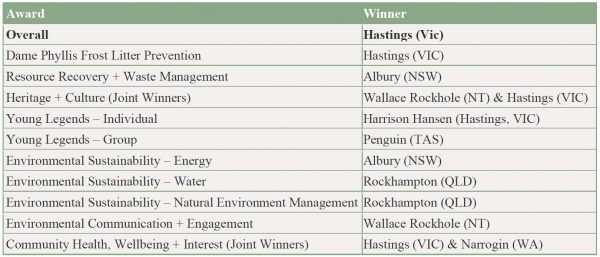
Hastings was also awarded winner of the Dame Phyllis Frost Litter Prevention category award and was the joint winner in the Heritage and Culture (with Wallace Rockhole, Northern Territory), Community Health, Wellbeing and Interest (with Narrogin, Western Australia) categories.
Hastings local, Harrison Hansen, was awarded winner of the Young Legends (Individual) category.
Australian Sustainable Communities – Tidy Towns judge Gail Langley said the town – located on Victoria's Mornington Peninsula – won four of the nine categories and scored highly in the remaining five categories.
"The Hastings Keep Australia Beautiful working group showcased their town and showed there is a strong focus on striving to become more sustainable each year, with the community demonstrating consultation, collaboration and inclusion to implement successful projects," commented Ms Langley.
"Hastings has demonstrated a strong focus on determining perceived needs of future generations as well as valuing and caring for the abundant natural resources in their local area.
"The community not only caters for those living in the town but also extends the community spirit of support to others, as demonstrated during the devastating 2020 bushfires, with the Hastings community becoming pivotal in assisting 4,000 Mallacoota beach evacuees."
Val Southam, Chief Executive Keep Australia Beautiful commended all the finalists in this year's Awards.
"Entrants in the Sustainable Communities – Tidy Towns competition, who are largely volunteers, are some of the most dedicated and passionate people we are fortunate enough to be involved with.
"In addition to a healthy dose of competition, the awards bring together community leaders, environmental champions, young legends and waste warriors from every corner of our great country to share experiences, learn from and inspire each other.
"This is the true Sustainable Communities – Tidy Towns spirit."
CONTACT DETAILS:
Judge Contact:
Gail Langley langley@agsystems.net.au
National Media Comment:
Val Southam, Chief Executive, Keep Australia Beautiful ceo@kab.org.au 0419 016 401
EDITOR'S NOTE:
About the Australian Sustainable Communities Awards
Keep Australia Beautiful seeks to lead, challenge and inspire all Australians to strive for a sustainable and litter free environment. It does this through research, communications programs and awards programs.
Its national awards are known as the Australian Sustainable Communities – Tidy Towns Awards. The Awards program commences with state and territory awards and culminates in a national Grand Final event.
© 2021 Keep Australia Beautiful National Association | ABN 35 743 600 611
Keep Australia Beautiful acknowledges the traditional custodians throughout Australia and their continuing connection to the land, waters and community. We pay our respects to all members of the Aboriginal communities and their cultures; and to Elders both past and present.
In The Spotlight
Glenn Brooks-MacMillan
Recently-appointed Program Manager, WPB Foundation
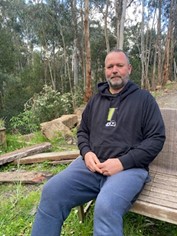
What makes Glenn tick?
Dusty, Dusty, Dusty! Sorry, I am a diehard tiger fan. And boy what a blast the last four years have been for me and my family. I enjoy going to the footy with my three daughters and spending time with friends reminiscing the good old days. I am also a grass roots landcarer with several covenanted properties to maintain and protect. I enjoy working with the community to enhance our environment and to see small projects grow big.
Tell us a bit about your professional background
I started my professional days in the 90s at BHP in Hastings as an Electrical Engineer. I was very fortunate to work on some quite large projects and very quickly appreciated the environmental impacts of making steel. I enjoyed working with the company to find new and innovative ways to operate more sustainably and proud of being part of orchestrating their first site energy/environmental management plan.
From there, I took further studies in Engineering Maintenance Management and Natural Resource Management to help complement the many opportunities such large industries have in operating more sustainably. I had a passion for new emerging technologies, so I started my own company to explore a range of sustainable solutions for a variety of different companies throughout Victoria.
One particular interest was working in the agricultural industry of which further studies in Conservation Land Management has enabled me to find my feet in empowering sustainable land management practices across many different sectors.
From being a volunteer minute-taker at my local Landcare Group, to now enjoying several Landcare Facilitator roles throughout Victoria and delivering large NRM projects, I am very proud of being able to turn a passion into a career.
What led you to join the Biosphere Foundation?
I was born and grew up in Frankston in the 70s & 80s and moved to Berwick to start my family with my wife Kelly and have always lived in the Dandenong Ranges. I travelled to Hastings for 20 years for work and still enjoy meeting family and friends on the Peninsula. My first introduction to the Biosphere was through my local landcare group. I am part of a passionate group of people helping to protect and enhance the Cardinia Creek which starts at the head waters of the Cardinia Reservoir and ends at Western Port. My local Casey Council rep let me know about a large project that the Biosphere Foundation was undertaking, Growing Connections, and before I knew it our volunteers were inundated with resources to help complement their work upstream of the bay. Over several years I became more aware of the great work the Foundation was doing and when I heard Greg Hunt had taken on the EO role, my previous work with him on Agricultural Greenhouse Gas Emissions Reduction Program attracted me to apply to some vacancies. With a background of working within Landcare Networks across Victoria for many years I was particularly interested in gaining experience in how an organisation like the Foundation worked collaboratively across many different Landcare Networks, user groups of the bay, Councils, Government Land Managers, private landowners and industries with conflicting objectives and priorities.
What would you like to achieve as Program Manager of the Biosphere Foundation?
I am very interested in spending time working with a passionate Board of like-minded people all wanting to make a difference. I am looking forward to working as a team to help uphold the UNESCO and RAMSAR programs that in principle I see is about show casing how society can function sustainably while living in and protecting a hot spot of high biodiversity environmentally.
I see the Biosphere Foundation can help collaborate, educate, and support existing programs and initiatives across the Peninsula and Western Port. In addition, I would like to explore new and innovative programs to further build resilience and capacity in our community to best adapt and mitigate the risk of climate change.
CEO Report
Mel Barker, CEO, WPB Foundation
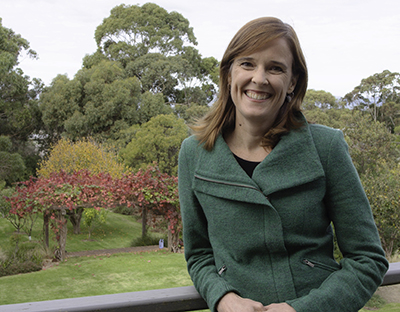
Since the winter newsletter we've had two new additions to the Biosphere Foundation team. Firstly, Glenn Brooks-MacMillan has joined us as our Program Manager. Glenn has worked across a range of roles in his career and brings a depth of practical experience. You can read more about Glenn below as we asked him to be our 'In the Spotlight' profile for this edition. Katerina Palthe has also joined the Foundation team as an intern until Christmas. Kat is studying at the University of Melbourne and is helping us with a number of projects. For this edition of Connector she's written an article about her research into Spartina, an invasive weed.
Unfortunately, our office in Hastings is closed due to COVID restrictions so Glenn and Kat have joined Sarah, Lance and I working from home. Stephen Brend, our Project Officer, returned to the UK for family reasons a few months ago, but continues to work for the Foundation on a casual basis. Whilst technology does come with frustrations at times, it does enable people to locate their virtual office anywhere – including England!
Closer to home, I was delighted to hear that Hastings won the Keep Australia Beautiful 2021 Australian Sustainable Communities – Tidy Towns Award. Hastings also featured in several other awards, including the Dolphin Research Institute's I Sea I Care Marine Ambassador Program. It's great to see all the efforts of local communities and organisations within the UNESCO Biosphere Reserve being recognised nationally.
I hope you enjoy reading the articles in this edition about the work we have been doing – including funding repairs to a bandicoot safe haven and undertaking water stewardship projects at two new sites. COVID restrictions inevitably throw up a few hurdles but we're becoming adept at figuring out a way of navigating around the obstacles so we can keep focussed on delivering against our strategic goals.
Source: https://www.biosphere.org.au/category/connector-newsletter/page/4/
0 Response to "Biosphere How to Draw a Step by Step Easy Dog"
Post a Comment